


How A Legendary John Hacker Commuter Yacht Was Reimagined With Contemporary Engineering
Feadship’s CEO Henk de Vries offered a simple but profound compliment when he first saw the newly completed Posh: “This is one of the prettiest boats I have ever seen.” For those who understand the lineage of this vessel and the meticulous effort invested in its creation, that praise carries the weight of genuine recognition. A decade ago, a design office undertook an ambitious project to honor one of American powerboating’s greatest legacies while pushing the boundaries of what modern engineering could achieve. John Hacker stands as the preeminent American powerboat designer of the twentieth century. His revolutionary hull shapes emerged from lessons learned designing floats for the Wright Brothers’ airplane in 1911, and his innovations claimed more than twenty world-speed records. During the 1930s, Hacker designed three extraordinary vessels built by Huskins Boat Works in Bay City, Michigan: Tempo, owned by Guy Lombardo; Thunderbird, which remains a Lake Tahoe legend; and Posh. These three boats represent the Triple Crown of the golden age of wooden vessels, and all three survive today as testament to Hacker’s genius.
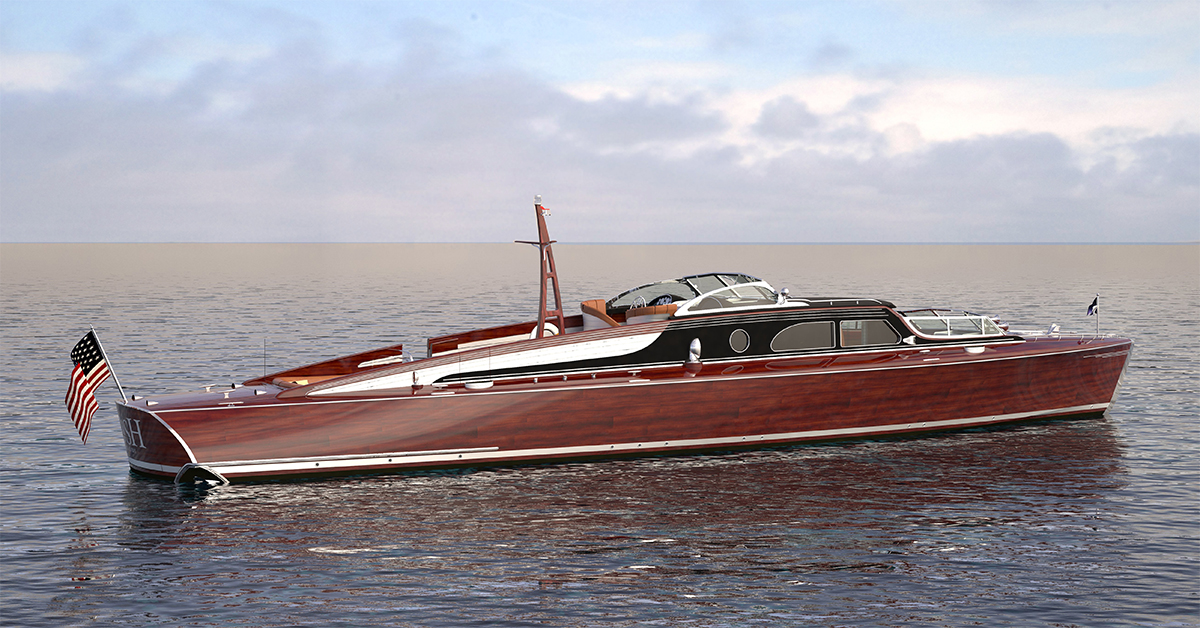
The original 52-foot Posh had passed through notable hands before the modern reimagining began. Canadian newspaper magnate Conrad Black once owned the mahogany classic, followed by collector Todd Warner. Today, the original rests in the collection of Dana Mecum, the renowned collector-car auctioneer. But the story of how a new Posh came to exist is far more intricate than a simple homage. The design brief called for something audacious: create a modern sister to Hacker’s masterpiece while remaining faithful to the Art Deco era that defined the original. The owner granted a blank-check approach, demanding only that the result be fabulous and historically respectful. The design team gained access to the original boat and had it laser-scanned to capture the precise hull and deck shapes that made Hacker’s creation legendary. This digital foundation would prove essential to the project’s success. Modern expectations demanded capabilities that would have seemed like pure fantasy in the 1930s. The new Posh required a Seakeeper gyroscopic stabilizer, twin V12 Rolls-Royce engines, air conditioning, and all the contemporary systems expected aboard a luxury vessel. These additions meant the new hull would need to be fundamentally different from its ancestor, despite maintaining visual harmony with the original design.
The engineering team increased the hull length by two feet and the beam by nine inches compared to the original. Four additional inches of freeboard were incorporated to accommodate modern occupants of taller stature. The deadrise was dialed up to provide a more refined blue-water ride suitable for Monaco and Mediterranean cruising. Most critically, displacement was increased by 2,650 pounds to carry the Seakeeper, air conditioning systems, and other modern equipment. Every waterline and buttock angle was tweaked to optimize performance at higher speeds than Hacker’s original could ever achieve. Securing the engines proved to be its own adventure. The design team reached out to BMW North America with an unusual request: they needed Rolls-Royce V12 engines stripped of automotive sensors like steering angle inputs and speed limiters. BMW initially resisted, but eventually agreed to provide what the team called “dumb” engines with no warranty whatsoever. The client invested considerable effort in promoting this modern classic. The precious original Posh was trailered from Minnesota to Fort Lauderdale to serve as the VIP tender at a lavish waterfront celebration where the America’s Cup itself graced the hors d’oeuvres table on the lawn of a palatial estate. The logistics proved challenging when a trailer axle snapped somewhere in Georgia, requiring emergency weld repairs performed beneath the delicate wooden hull.
As the evening’s festivities approached, the original Posh made a dramatic appearance, floating across the South Federal Highway overpass at Route 595—a moment of perfect timing that seemed almost choreographed. The final preparations were frantic. Eight hours of meticulous mahogany polishing concluded with a dozen champagne bottles shattering across the teak sole moments before the first guests arrived. Engine hatch open. Glass shards and ice shoveled into the bilge. Engine hatch closed. Exactly eighty-seven seconds later, the first VIPs were aboard. The new Posh represents far more than a nostalgic recreation. It is a dialogue between eras, a conversation between Hacker’s timeless design principles and twenty-first-century capability. The laser-scanned hull forms honor the original’s proportions while the modern engineering ensures performance and comfort that would have seemed miraculous to the boat’s 1930s creators. Every detail, from the Art Deco aesthetics to the hidden systems that power modern cruising, reflects a commitment to excellence that Hacker himself would have recognized. What makes this project remarkable is not merely the technical achievement, though that is substantial. Rather, it is the philosophical approach: respecting the past while embracing the future, maintaining visual integrity while delivering contemporary performance. In an era when many choose between preservation and progress, the new Posh demonstrates that the finest approach honors both. The Feadship CEO’s assessment—that it is one of the prettiest boats ever built—speaks to the success of that balance.
This article has been sourced from press releases and cross-referenced with multiple websites. Facts originally seen at Source.


